


Every Size, Not Just Large Fund Houses
A single-strategy boutique AIFM needs an LEI for its fund just like a large multi-strategy manager does. Boutique and large managers are equally in scope.

Select Your Jurisdiction
Currently selected: Australia|

Search region…
Asset managers, AIFMs and UCITS management companies operate under some of the most overlapping LEI obligations in finance, AIFMD, EMIR, MiFID II and SFTR can each require a valid LEI for the same fund, and a single lapsed code can trigger failures across more than one reporting regime at once. LEI System registers and maintains LEI codes for every fund, sub-fund and counterparty in your range, backed by GLEIF accreditation and a 150-jurisdiction reach.


LEI System is an official LEI Registration Agent
Latest LEIs issued:
984500F4100AB5956011 | QUINNCOM INTERNATIONAL PTY LTD
The requirement reaches every fund structure a manager runs, and
relevance has nothing to do with company size.
A single-strategy boutique AIFM needs an LEI for its fund just like a large multi-strategy manager does. Boutique and large managers are equally in scope.
AIFMs need LEIs for the funds under management and for the manager entity itself, both used across AIFMD regulatory reporting.
UCITS funds and their management companies need LEIs for regulatory identification, with each sub-fund typically requiring its own separately registered code.
Administrators handling LEI registration on behalf of the funds they service manage the same identifier lifecycle a manager would, often across a larger multi-client portfolio.
Prime brokers, custodians and trading counterparties to a fund need their own current LEI for the fund manager's EMIR and SFTR reporting to be complete.
Overlapping regulation is the reason to register properly. These are the operational problems it solves along the way.
| Problem | How the LEI Solves It |
|---|---|
| A missing fund LEI causes an EMIR derivatives report to fail validation | A current, ISSUED-status LEI on the fund lets the report pass cleanly |
| Sub-funds within an umbrella structure are hard to report individually | Each sub-fund gets its own LEI, resolving to its own verified record |
| A counterparty's lapsed LEI blocks a trade at the worst possible moment | Portfolio-wide status monitoring flags lapses before they block a trade |
| Tracking LEIs across a large, multi-fund range doesn't scale manually | LEI Manager's dashboard tracks every fund's code status and renewal in one place |
| Determining who is responsible for a fund's LEI, the fund or the manager, causes confusion | One centralized account clarifies and manages responsibility across the whole range |
Beyond satisfying a regulation, this is where the LEI actually gets used day to day.
Populate a derivatives transaction report with the fund's LEI and the counterparty's LEI, both required for the report to validate under EMIR.
Reference the fund's and the AIFM's LEI in AIFMD reporting, with each sub-fund in an umbrella structure typically filed under its own separate code.
Confirm a prime broker or trading counterparty's LEI is current and ISSUED before executing a trade on a fund's behalf.
Include LEI codes for both the fund and its counterparty in repo, stock lending or margin financing reports required under SFTR.
Register a new fund's LEI as part of the launch process, so the identifier is in place before the fund's first reportable transaction.
Few sectors carry as much overlapping LEI obligation as asset management, the same fund can trigger AIFMD, EMIR, MiFID II and SFTR reporting requirements simultaneously, each with its own rules but the same underlying need: a verified, unambiguous identifier for every fund, sub-fund and counterparty involved.
A single LEI per entity, rather than a different reference for each regulatory regime, is what makes it possible to satisfy all of them from the same underlying record instead of reconciling separate identifiers across four reporting frameworks.
Regulatory compliance is the reason managers register fund LEIs. What it changes operationally is the reason it's worth doing properly.
Regulatory compliance is the reason managers register fund LEIs. What it changes operationally is the reason it's worth doing properly.
A current LEI on a fund satisfies AIFMD, EMIR, MiFID II and SFTR reporting simultaneously, instead of a single lapsed code causing failures across all four.
Giving each sub-fund its own LEI means regulatory reporting can identify the exact reporting entity, rather than an ambiguous reference to the umbrella structure.
Portfolio-wide LEI status monitoring surfaces a counterparty's lapsed identifier before it blocks a trade, rather than discovering it at execution.
Asset managers face one of the most overlapping LEI compliance environments of any sector, where a single lapsed code can trigger failures across multiple regimes at once.
All Alternative Investment Funds and their managers report the LEI under AIFMD Annex IV reporting, with each sub-fund within an umbrella structure typically requiring its own separate code, though ESMA's guidelines permit an Interim Entity Identifier or BIC as a fallback where an LEI genuinely isn't available. AIFMD 2.0, in force since April 2026, is expected to tighten this toward a stricter LEI requirement once new technical standards land in 2027.
EMIR requires LEI codes for both counterparties to every OTC derivatives transaction, so a manager must ensure both the fund and its trading counterparties hold active, ISSUED-status LEIs.
Investment firms submitting MiFID II transaction reports must include valid LEIs for all counterparties, with the manager responsible for ensuring fund entities hold the required identifier.
The Securities Financing Transactions Regulation requires LEI codes for counterparties and collateral issuers, covering managers involved in stock lending, repo or margin financing.
| Regulation | Applies To | What It Requires |
|---|---|---|
| AIFMD | AIFs and their managers | Valid LEI per fund, typically per sub-fund too |
| EMIR | OTC derivatives transactions | LEI for both the fund and its counterparty |
| MiFID II | Transaction reporting | Valid LEI for all reported counterparties |
| SFTR | Financing transactions | LEI for counterparties and collateral issuers |
| SEC Form PF | US-based advisers with $150M+ in private fund AUM | Form PF filings via EDGAR must include LEI numbers; amended rule compliance date Oct 1, 2026. |
Individual registration works for a single fund. Managers running a real fund range rarely stop there, sub-funds and counterparties all need identifiers tracked at once.
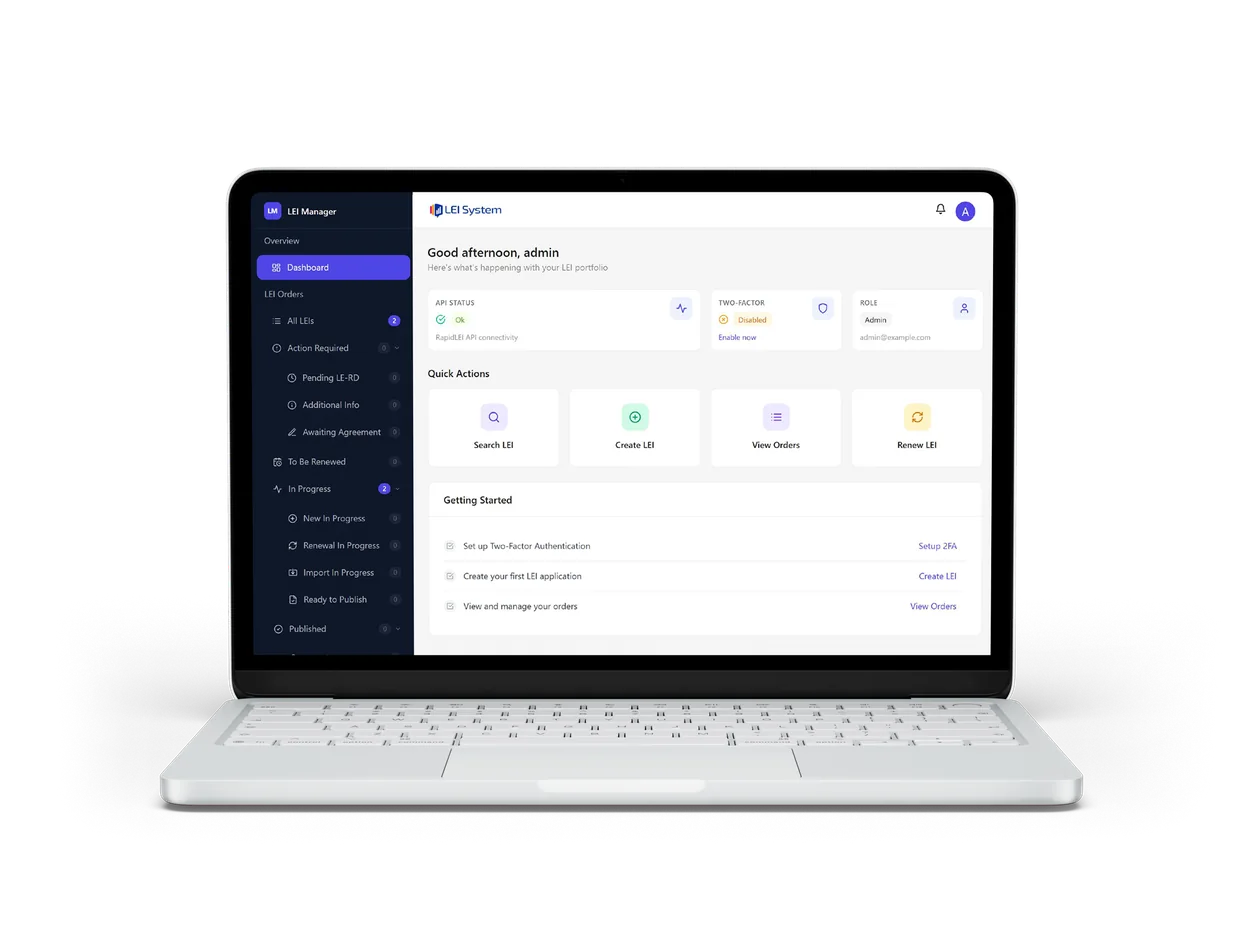
LEI Manager is LEI System's platform for exactly that.
Explore LEI ManagerMonitor LEI status, renewal dates and data accuracy for every fund and sub-fund in your range from one account, with automatic renewal so no code lapses ahead of a reporting deadline.
Integrate LEI registration, lookup and status verification directly into trade execution and reporting systems via the LEI Manager API.
Register LEI codes for multiple funds, sub-funds and counterparties simultaneously, useful when launching a new umbrella structure with several sub-funds at once.
Getting registered is a five-minute online process, not a paperwork exercise. Submit your entity's legal name and registration details, LEI System verifies them against official business registries, and your code is issued and published to the GLEIF Global LEI Index, immediately checkable by any counterparty or regulator who looks it up.

Pick a subscription plan and complete the online application with your entity's legal name, address and registration number.


Our system verifies your entity data against official business registries in real time, notifying if additional documents are needed.

Your LEI code is issued, recorded in the Global LEI Index and delivered to your email address along with a confirmation.
Every LEI System plan includes the GLEIF fee, lapse protection, and automatic annual renewal, so a code stays in ISSUED status for every transaction it is used in, not just the first one.

Kristian Hein, November 23
Europe is moving towards common standards for tokenised securities as digital technologies reshape capital markets. The new European Tokenisation Standards Group will focus on connecting financial systems and building on established industry standards. This article explores how the Legal Entity Identifier (LEI) and its digital counterpart, vLEI, support trusted identification, automated verification and interoperability across the next generation of financial markets.
Read more
Kristian Hein, November 18
The Financial Stability Board’s 2026 cross-border payments report highlights the UK’s CHAPS system as a live example of how Legal Entity Identifiers are moving into payment infrastructure. CHAPS handles everything from time-sensitive business and property payments to large financial-market settlements. Its financial-institution layer carries 73% of the value settled, making LEI data especially relevant for risk management, compliance, counterparty identification, and automated processing.
Read more
Kristian Hein, November 11
Does a branch need its own LEI, or should it use the head office’s code? Opening a foreign branch does not automatically create a separate LEI requirement. This guide explains the difference between branches and subsidiaries, when reporting rules call for the head office’s LEI, and when a branch may need its own. Find out what to check with your bank, broker or supervisory authority before applying.
Read more








 Affordable
 Lapse Guard
 Auto Renewals
 $99 total